 Peter Fortunato is an award winning writer, performer, ceremony maker, visual artist, and teacher. He is the author of four books of poetry: Entering the Mountain, Late Morning: New and Selected Poems, Letters to Tiohero, and A Bell or a Hook, as well as a book for children, Color Me Earth, and the author of the novel, Carnevale. Peter’s memoir, Desert Wind: My Life in Qatar, was published by Cayuga Lake Books in April 2023. He lives in Ithaca, NY, where he maintains a private counseling practice specializing in hypnosis.
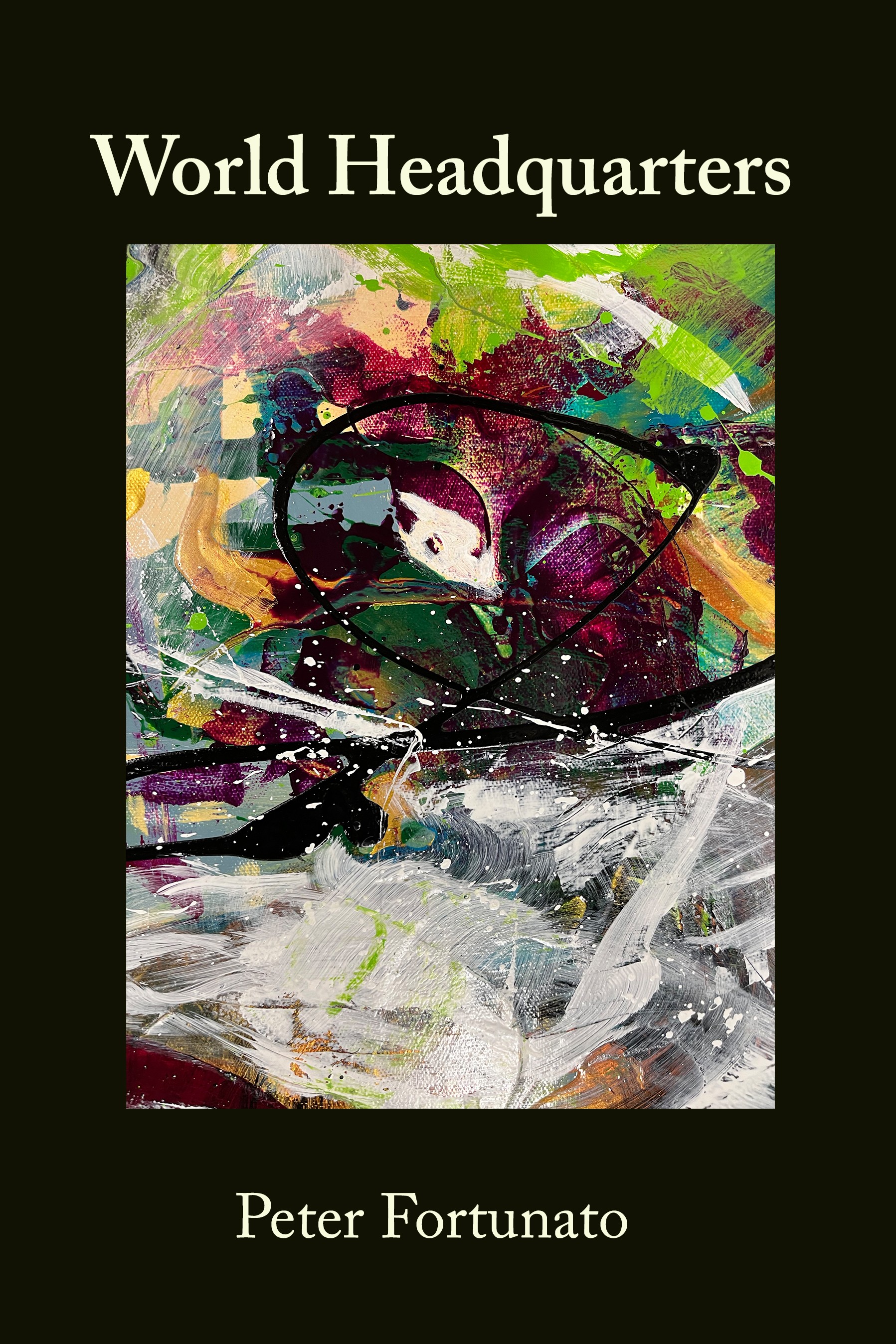 CLB editor Peter Fortunato has recently published with Fomite Press of Vermont his latest poetry collection, World Headquarters. (Fomite also published Peter’s novel Carnevale in 2019.) The three sections of World Headquarters resonate with and reinforce the interconnectedness among the local and universal, the personal and political, the human and non-human worlds. Poems comprising Part II, ad-Dawha, were begun while Peter Fortunato lived in Doha, the capital of Qatar. During the rapid modernization of that desert emirate, Fortunato taught four years at the newly opened Weill Cornell Medicine. But where exactly is the world’s headquarters—these poems dance across the horizons of the mind, unlimited in its essence, particular in its myriad expressions.
An Interview With Peter Fortunato
Conducted by Shivana Souchet
- What draws you to poetry specifically as a writing form?
Poetry is the most concise and versatile form of written expression. It’s especially suited for communicating truths that are known in the heart. I try to live according to the wisdom of my heart, and so sometimes there are experiences and ideas that naturally want to be communicated as poems. Sometimes, also, I simply have a feeling, maybe even a rhythm in my bones that shapes itself through a process of discovery as a poem.
- Who are some poets that have inspired your writing? In what ways have you drawn from them?
My collection World Headquarters has several poems that refer to a few of the poets who have been important to me: Emily Dickinson, Denise Levertov, Allen Ginsberg, Robert Creeley, and Stanley Kunitz. These are only a few of the many, many writers who have influenced me. My long friendship with the American poet Gary Snyder has helped to shape much that I’ve done in my life, especially my spiritual path as a practitioner of Zen and Tibetan Buddhism and shamanism. I consider myself an American poet, but Asian sensibilities and poetic forms are very important to me. And needless to say I’ve also been greatly influenced by literature in English, especially the Romantic poets, William Blake and Percy Bysshe Shelley.
- When did you feel this collection was finished?
It takes me a long time to be satisfied with a collection of poems or a book in any genre, such as my memoir, Desert Wind: My Life in Qatar. I revise individual pieces a lot, and then there’s the organic process of fitting together the pieces according to a thematic structure. With a book, a lot falls by the wayside when I’m doing the final editing.
- Many of your poems, such as “World Lit,” detail your experiences in Qatar. How did living there influence you as a writer and your work?
The poems in the middle section of World Headquarters all refer to my outer and inner experiences while living in Doha, capital of the Gulf Arab nation of Qatar. They’re central to the collection because they come from inner places that were as sharply experienced as my outer conditions. I want to teach people a little about Qatar, an important US ally in the Arab world, and as I said, a poem can do a lot very concisely. Many of these poems were begun during the four years when I was teaching writing to future doctors at Weill Cornell Medicine. My memoir goes into these experiences in other kinds of ways, but I was always open to the inspiration of poetry while feeling myself to be the proverbial “stranger in a strange land.”
- How did you decide on the title “World Headquarters”? Can you tell your readers more about the nature of this phrase?
The title is a play on the way governments and corporations refer to themselves and their projects; you know, like “central command” or “the main office.” Each of us is the locus of a “world headquarters”—on one level, it has to do with our subjectivity and sense of self-importance, on another level the title has to do with the ways we project our reality.
- “Corona Crisis Search Results” is a poem that speaks to the time of the pandemic. What was your experience as a writer during this time?
The period of lock-down during the height of the pandemic didn’t impact my way of life so very much. I live close to nature and have property that borders Six Mile Creek, and so I was able to be outdoors often. I enjoyed the universal slowdown, although the early foot-dragging by the former President proved tragic. Like many people, I spent a lot of time online, searching for news and reflecting on our shared human condition, as my poem indicates.
- What themes, if any, do you find yourself returning to most often in your poetry?
What I find very interesting at this stage of my poetic career—I’ve been writing for most of my life and publishing for more than 50 years—is how certain themes emerge rather organically. Even when I start to write with a subject in mind, my unconscious is going to gather material for me to shape at a conscious level. So, the short answer to your question is that human nature is my major theme, and by that I mean all of nature, because it’s what we are.
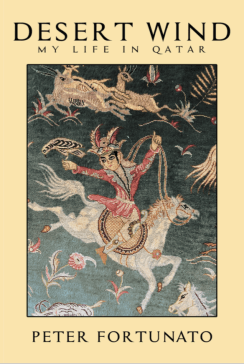
Peter Fortunato lived and worked in the Persian Gulf emirate of Qatar during an exciting, transformational time for that Muslim nation, as well for him, personally and professionally. A poet and a Buddhist, the author taught at the newly opened branch of Weill Cornell Medical College in Qatar’s capital, Doha. His memoir is a rich account of the surreal quality of life in this petroleum-wealthy, desert nation. Available now on Amazon.
Praise for Desert Wind: My Life in Qatar
Readers will be engaged by the author’s vivid evocations and zest for life at the rare intersection of cultural exploration, poetry, psychology, politics, education, spirituality, the thrill of nature, and a sense for the beyond. The book is a whole journey in itself!
—Patrick Laude, Georgetown University
The author’s personal account of his life in this desert oasis, and his insatiable appetite to learn about the culture and its people, give us a behind-the-scenes look into his experiences there as a poet, teacher, student, and explorer.
—Nounou Teleghani
Desert Wind is a fascinating account of Peter Fortunato’s adventures and contains engrossing conversations with people of many nationalities and all walks of life. Readers will learn about Qatari culture, the views of Asian and Western expats working in the country, and his students’ aspirations and interactions with this wise teacher. In the end, Fortunato undergoes his own transformation of profound self-acceptance and compassion.
—Alice McDowell, Ph.D., author of Dance of Light and Hidden Treasure
Desert Wind joins other memoirs of adventures in foreign places, and will delight readers curious about contemporary Arab culture and in particular about Qatar, often mentioned in the news, but still vague to most Westerners. For comparison, Reading Lolita in Tehran by Azar Nafisi, a perennial best seller, comes to mind, but so far, Mr. Fortunato’s account of his expatriate life in Qatar is unique in its breadth—nor has anyone else examined their experiences in this Muslim state through the lens of Buddhism.
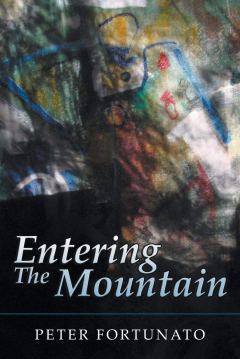
Entering the Mountain, Peter Fortunato’s 2017 collection, includes the book’s title poem and several other long poems concerned with love of family, myth-making, and mortality. Among these is Mr. Fortunato’s elegy for his father, “Every Wizard,” chosen for a Pablo Neruda Award by Stanley Kunitz, who told the author, “You’ve discovered your legend. Now where will it take you?” Entering the Mountain is the result. Buy it now at Amazon.com.
Praise for Entering the Mountain:
Peter Fortunato’s [early poetry] owed much to Gary Snyder; his recent work—by far his most adventurous and poignant—evinces the umbilical break: these are poems that brilliantly meld personal history, myth, and the heart’s irrefutable music. In earlier Fortunato poems, one could see the wheels working. The new poems seem to rise from the mouth of revelation: it is as if the loss of his mother and father, finally, has given him the presence to throw off the conventions and the dog-eared. The great poem, “Every Wizard,” like so much in this fine collection, is not only a testimony to history—his father’s complicated immigrant experience—but to how each of us must honor the weight of love. We can celebrate Art, craft, and the intricacies of how a poem makes us feel, but Fortunato, like a seer, reminds us of the mind’s irrepressible provender and the heart’s irreducible calculus.
—Kenneth A. McClane
The first thing we notice about the poetry of Peter Fortunato is the strength of voice as he delves into memories of family and kinship, and a cultural heritage going back to Italy and even classical Greece. An important theme in Entering the Mountain is performance, performance of music, of magic, escape artistry, the performance of rituals and celebrations of both the living and the dead, acts of homage and affection in our daily lives. Some poems are vivid portraits, others home movies. All carry us deep into the mountain of memory, sometimes painful, always thrilling.
—Robert Morgan
The poems in Peter Fortunato’s Entering the Mountain walk the reader into a world that is full of mystery yet grounded in the poet’s commitment to seeing and recording the natural world and his place in it. We watch as he watches the woodpecker, his words transiting the creature into flame: “And what became of the thundering lizards / who slid their skins who maybe / rose on wings like the phoenix?” The poet shares his life with us, inviting us to “. . . taste that memory / take that cup today.” He moves us back and forth through time, guiding us through his early days and introducing us to the people who inhabited that time with him, inviting us to be part of his magician’s story.
—Bertha Rogers
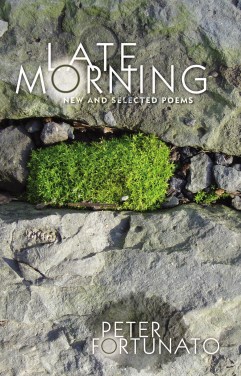
Late Morning: New and Selected Poems by Peter Fortunato surveys almost forty years of work, beginning with selections from his earliest published collections, A Bell or a Hook and Letters to Tiohero. Themes that compel Fortunato’s work are love of nature and human love, the revelatory power of dreams, and spiritual practice rooted in Buddhism. Winner of numerous awards for his writing, including the Emily Dickinson Prize of the Poetry Society of America, and a Pablo Neruda Prize from the Arts and Humanities Council of Tulsa, Peter Fortunato is a writer, performer, ceremony maker, visual artist, and teacher. He also maintains a private counseling practice specializing in hypnosis. He lives in Ithaca, New York with his wife, the poet Mary Gilliland. You can find Late Morning: New and Selected Poems at Amazon.com.
Reviews and Interviews:
Jacqueline Gens for Tsegyalgar East Community Blog
Learn more about Peter’s novel Carnevale at his website: www.peterfortunato.net
Read a book review at:
https://booktrib.com/2019/11/01/go-on-carnevale-with-this-debut-literary-mystery/
 Cayuga Lake Books